Dual Diagnosis Guide: Navigating Co-Occurring Disorders

Reach out now, we can help
Home / Archive by category "News" (Page 25)

Dual Diagnosis Guide: Navigating Co-Occurring Disorders

19 January, 2024Articles, News

Individuals grappling with both mental health disorders and substance abuse face a unique set of challenges. This intricate interplay of conditions, known as dual diagnosis or co-occurring disorders, requires a nuanced and integrated approach for effective treatment. This comprehensive guide aims to shed light on the complexities of dual diagnosis, offering insights into its prevalence, common combinations of disorders, and evidence-based strategies for successful navigation.

Take the First Step Towards Recovery

Embark on your journey to recovery from co-occurring disorders. Reach out to our dedicated team in Johannesburg and Pretoria. Your path to holistic well-being starts here.

Connect with Our Expert Team for Personalized Dual Diagnosis Support

Understanding Dual Diagnosis

Prevalence of Dual Diagnosis: The co-occurrence of mental health disorders and substance abuse is not uncommon. According to the Substance Abuse and Mental Health Services Administration (SAMHSA), nearly 9.2 million adults in the United States had co-occurring disorders in 2019. Understanding the prevalence is crucial for recognizing the scope of the issue and advocating for improved mental health services.

Common Combinations: Various mental health disorders can coexist with substance abuse, complicating both diagnosis and treatment. Common combinations include depression and alcoholism, anxiety and cocaine addiction, or schizophrenia and cannabis use. Recognizing these patterns helps tailor interventions to address specific challenges.

Assessment and Diagnosis

Integrated Assessment Approaches: Successful diagnosis and treatment begin with comprehensive assessments. Professionals employ integrated assessment approaches that consider both mental health and substance abuse components. The Substance Abuse and Mental Health Treatment Locator by SAMHSA is a valuable resource for finding assessment services.

Challenges in Diagnosis: Identifying co-occurring disorders can be challenging due to overlapping symptoms. The Diagnostic and Statistical Manual of Mental Disorders (DSM-5) provides guidelines for clinicians to navigate this complexity, emphasizing the importance of a thorough evaluation.

Treatment Modalities

Integrated Treatment Models: Integrated treatment, where mental health and substance abuse issues are addressed simultaneously, has proven effective. SAMHSA’s Treatment Improvement Protocols offer guidelines for implementing integrated approaches. Programs like Dual Diagnosis Anonymous provide support groups tailored to individuals dealing with co-occurring disorders.

Pharmacotherapy: Medications play a crucial role in managing co-occurring disorders. Psychiatric medications, combined with substance abuse treatments such as medication-assisted therapy (MAT), can significantly enhance recovery outcomes. The National Institute on Drug Abuse (NIDA) offers resources on MAT for opioid use disorders.

Recovery and Support

Peer Support Programs: Peer support is integral to the recovery process. Organizations like Mental Health America provide information on peer support programs, connecting individuals facing dual diagnosis with others who have walked a similar path.

Family Involvement: Engaging families in the treatment process is vital. The National Alliance on Mental Illness (NAMI) offers resources for families, helping them understand and support loved ones with co-occurring disorders.

Prevention and Advocacy

Educational Initiatives: Prevention is a key component of addressing dual diagnosis. Educational initiatives, such as those by the National Institute of Mental Health (NIMH) and the National Institute on Drug Abuse, aim to raise awareness about the risks and consequences of co-occurring disorders.

Policy Advocacy: Advocating for policies that prioritize mental health and substance abuse treatment is essential. Organizations like Mental Health America and the National Council for Behavioral Health provide resources for individuals interested in advocacy efforts.

Navigating co-occurring disorders requires a comprehensive and compassionate approach. By understanding the prevalence, utilizing integrated assessment approaches, and implementing evidence-based treatment modalities, individuals with dual diagnosis can achieve successful recovery. Support from peer groups, involvement of families, and active engagement in prevention and advocacy further contribute to the holistic well-being of those facing the complex challenges of co-occurring disorders.

In conclusion, navigating co-occurring disorders demands a collective effort to break down barriers and foster a supportive environment. As we strive to understand the complexities, prevalence, and treatment modalities of dual diagnosis, it becomes evident that compassionate care, integrated approaches, and community support are the cornerstones of successful recovery. By embracing a holistic perspective, individuals facing co-occurring disorders can find hope, healing, and the resilience needed to reclaim their lives. The journey may be challenging, but with the right resources and support, a brighter and healthier future is within reach.

No Obligation Addiction Assessment

Book a No Obligation Confidential Assessment at your nearest Treatment Centre Today.

Johannesburg Admissions: +27 74 895 1043
Pretoria Admissions: +27 82 653 3311
Close

Stories of Recovery

  • The encouragement, love and support from the team at Crossroads allowed me to eventually see that I was worth something - that my life could be turned around and that I could accomplish the things that had long been a forgotten dream.
    Oliver VG
    Read more
  • On the last day of my stint at Crossroads I could only express gratitude towards all who works there. A wise councillor once commented on my question when one is ready for rehab by explaining that when one is ready for rehab, rehab is ready for you.
    Johan B
    Read more
  • I was lost and my soul was broken until I ended up at Crossroads and was introduced to the Twelve Steps. With the help of their excellent staff and amazing support I have recently been clean for 18 months, I could not have done it without them!
    Carla S
    Read more
  • "Just for today I am more than three years in recovery. I have Cross Roads to thank for this wonderful gift. Cross Roads helped me to set a firm foundation in my recovery on which I can continue to build."
    Angelique J
    Read more
Left Arrow Right Arrow

Approved Medical Aids

Bestmed LogoBonitas LogoCAMAF LogoDiscovery Health LogoFedhealth LogoGovernment Employees Medical SchemeLiberty CorporateMedihelp Medical Scheme

Trust and Recovery: Guide for Renewed Connections

Reach out now, we can help
Home / Archive by category "News" (Page 25)

Trust and Recovery: Guide for Renewed Connections

12 January, 2024Articles, News

Embracing Renewal: Navigating the Journey of Trust and Recovery

Trust is something that must be earned through one’s actions and it is even harder to regain it after it has been broken because drug addicts lose a lot of the trust of their friends, family and loved ones. Being in recovery and not using substances anymore, facing your broken relationships and struggling with the social elements of your life is not going to be a walk in the park and as a result no one trusts you, everyone is always suspicious of you and they are all waiting for you to make another mistake.

Recovery Starts Here

Begin your journey to restored relationships and trust. Contact Crossroads Recovery Centre for comprehensive addiction recovery support in Johannesburg and Pretoria.

Rediscover trust, rebuild relationships. Your path to recovery and renewed connections begins at Crossroads.

Points to remember about restoring relationships in recovery

  • It will take time: Do not expect to restore your relationships in a day, meaning that you do not need to rush the process and put too much pressure on yourself.
  • Devise an action plan: When you feel more confident in recovery, making amends will be one of the few things you’ll need to do. For this to happen you would need to enlist the help of an addiction’s counsellor or a sponsor as they would be able to help you identify the things you did and said to hurt your loved ones, from then on you can devise an action plan to restore your relationships.
  • Be honest about your past: Let your loved ones know the times you have lied, cheated and stolen things. Admitting your faults is an important step in restoring your relationships in recovery.
  • Talk to God before talking to your loved ones and family
  • Make a commitment to notice the things the others do right, have fun together and be more involved by building meaningful and helpful relationship.
  • Practice Active listening: Active listening is an important tool for restoring relationships and it involves fully engaging with loved ones and paying attention to what they are saying.

Restoring relationships in recovery might be challenging, but it can be done by overcoming any obstacles with effort and commitment and a willingness to restore the relationships with your loved ones.

No Obligation Addiction Assessment

Book a No Obligation Confidential Assessment at your nearest Treatment Centre Today.

Johannesburg Admissions: +27 74 895 1043
Pretoria Admissions: +27 82 653 3311
Close

Stories of Recovery

  • The encouragement, love and support from the team at Crossroads allowed me to eventually see that I was worth something - that my life could be turned around and that I could accomplish the things that had long been a forgotten dream.
    Oliver VG
    Read more
  • On the last day of my stint at Crossroads I could only express gratitude towards all who works there. A wise councillor once commented on my question when one is ready for rehab by explaining that when one is ready for rehab, rehab is ready for you.
    Johan B
    Read more
  • I was lost and my soul was broken until I ended up at Crossroads and was introduced to the Twelve Steps. With the help of their excellent staff and amazing support I have recently been clean for 18 months, I could not have done it without them!
    Carla S
    Read more
  • "Just for today I am more than three years in recovery. I have Cross Roads to thank for this wonderful gift. Cross Roads helped me to set a firm foundation in my recovery on which I can continue to build."
    Angelique J
    Read more
Left Arrow Right Arrow

Approved Medical Aids

Bestmed LogoBonitas LogoCAMAF LogoDiscovery Health LogoFedhealth LogoGovernment Employees Medical SchemeLiberty CorporateMedihelp Medical Scheme

Building Resilience: Coping Mechanisms for Recovery

Reach out now, we can help
Home / Archive by category "News" (Page 25)

Building Resilience: Coping Mechanisms for Recovery

05 January, 2024Articles, News

Resilience is the ‘rubber ball’ factor: the ability to bounce back in the event of adversity. Put simply, resilience is the ability to cope with and rise to the inevitable challenges, problems and set- backs you meet in the course off your life and come back stronger from them. Resilience relies on different skills and draws on various sources of help, including rational thinking skills, physical and mental health, and your relationships with those around you and your Higher Power. Resilience is not necessarily about overcoming huge challenges; each of us face plenty of challenges daily, for which we must draw on our reserves of resilience.

Find Resilience in Recovery

Rebuild your life with resilience. Reach out to Crossroads Recovery Centre in Johannesburg or Pretoria for comprehensive addiction recovery services.

Discover a Stronger You with Crossroads Recovery Centre

Four Ingredients of Resilience

There are four basic ingredients to resilience:

  1. Awareness – noticing what is going on around you and inside your head;
  2. Thinking – being able to interpret the events that are going on in a rational way;
  3. Reaching out – how we call upon others to help us meet the challenges that we face, because resilience is also about knowing when to ask for help; and
  4. Fitness – our mental and physical ability to cope with the challenges without becoming ill.

The Link Between Thought and Emotion

When you can recognize and manage your emotions its important to apply reason to emotion to support your decision-making. But how you think can be affected by your emotional response to the situation, and part of being aware is understanding this and recognising it when it happens.

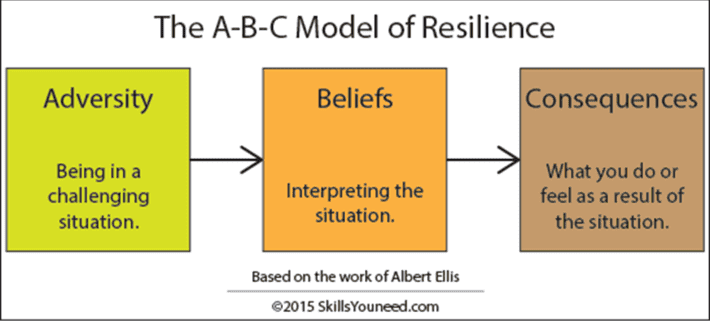
Psychologist Albert Ellis created a simple model for this, which he called A-B-C for Adversity – Beliefs – Consequences. This model sets out a process:

When Managing Emotions an emotion can sometimes be so visceral that there is no time to go through this process rationally: you simply react immediately to the situation by running away, screaming, or similar. But your brain has almost certainly gone through the process subconsciously.

It is also important to recognise that certain thoughts lead to certain emotions.

Example Include:
I’ve lost somethingSadness
Someone has done something to harm meAnger
I’ve hurt somebodyShame
I feel threatened by somethingFear

The benefit of understanding that these thoughts lead to these particular emotions is that by identifying the emotion we feel, we can understand what our subconscious thought processes may be. This may not be obvious otherwise, and it will help us to take the right action to address the problem.

Thinking Traps

So-called ‘thinking traps’ are traps into which we can fall in our thinking, usually at the ‘B’ stage of the A-B-C model above. Thinking traps are effectively assumptions about ourselves or the situation, made without examining the evidence, and are usually unhelpful.

  • The signs that you are falling into one of the thinking traps include the use of phrases like ‘never’, ‘always’, and ‘I…they…’, for example:
  • “I just can’t do maths”
  • “I’ve never been able to do things like that”
  • “They’ve taken it away from me”

If you’re thinking that this language sounds very childish, you’re right. Take a look at our page on Transactional Analysis to understand more.

You need to be alert to falling into one or more of these thinking traps when you are developing your beliefs about a situation because it could prevent you from acting effectively: in other words, thinking traps can prevent you from acting with resilience.

Improving Resilience Through Thinking

Having considered the elements of resilience, and the process of responding to situations, it may now be helpful to talk about what we can do to help develop resilience.

There are quite a number of useful techniques here, including:

1. Gathering More Information

You want to engage the rational part of your brain in your decision-making about the situation. One of the best ways to do so is to actively gather more information on which to base your decision.

Example…… Suppose that you see a snake by the side of the path. Your immediate reaction might be fear:

“A snake! It must be poisonous! I’d better run away!” [A-B-C]

But pause for a moment and gather more information. It might be dead. It might not be poisonous. It might be cold, and therefore only capable of moving very slowly.

There are all kinds of reasons why you might not need to run away. A crucial aspect of gathering more information is to think about alternative explanations for the situation.  Your brain, based on your experience and your belief system, will present you with what it considers to be the most obvious explanation.

But it may not be correct!

Thinking about alternatives, and then checking those against reality, perhaps by asking questions of others or looking something up, will help to ensure that you react appropriately to the situation.

2. Alternative Scenarios

We’re all prone to imagining the worst.

Your boss asks to speak to you, and you immediately imagine that you’re about to be fired. You get ready to defend your recent performance…

…but when you enter her office, it turns out that she wants you to know that she’s pregnant and you’re in line to take over her responsibilities while she’s on maternity leave, with a consequent pay rise.

Your child’s teacher asks for a quick word after school. You immediately assume that the child is in trouble …

…but no, they just fell and cut a knee at lunchtime. No harm done, but the school has to let you know.

Imagining the worst is also called catastrophizing, and it is surprisingly common.

There is a very easy way to deal with it, which involves generating alternative scenarios in your head:

  1. Imagine the worst – let your imagination run riot. What could have gone wrong? What might have happened?
  2. Now think about the best possible outcomes. How good could it get?
  3. Finally, think about the most likely outcomes – probably somewhere between the two. Make a plan for how you will respond to that.

These two strategies, gathering more information and looking for alternative scenarios, will help you to develop your resilience.

You will become more aware of what is going on around you, and inside your head (awareness). They will also help you to apply rational thinking to the situation, climbing out of any thinking traps into which you have fallen, and understanding and rationalising your emotional response to a situation.

Improving Resilience Through Reaching Out

No man is an island, entire of itself. Every man is a piece of the continent, a part of the main…  John Donne (English Poet)

There is no shame in asking for help. We all need help now and again, and many of us function much better when we are working with others.

A good part of resilience is knowing when and how to ask others for help, reaching out to those with whom we have relationships to resolve the problems with support.

Improving Fitness and Health

The final element of resilience is physical and mental health.

No Obligation Addiction Assessment

Book a No Obligation Confidential Assessment at your nearest Treatment Centre Today.

Johannesburg Admissions: +27 74 895 1043
Pretoria Admissions: +27 82 653 3311
Close

Stories of Recovery

  • The encouragement, love and support from the team at Crossroads allowed me to eventually see that I was worth something - that my life could be turned around and that I could accomplish the things that had long been a forgotten dream.
    Oliver VG
    Read more
  • On the last day of my stint at Crossroads I could only express gratitude towards all who works there. A wise councillor once commented on my question when one is ready for rehab by explaining that when one is ready for rehab, rehab is ready for you.
    Johan B
    Read more
  • I was lost and my soul was broken until I ended up at Crossroads and was introduced to the Twelve Steps. With the help of their excellent staff and amazing support I have recently been clean for 18 months, I could not have done it without them!
    Carla S
    Read more
  • "Just for today I am more than three years in recovery. I have Cross Roads to thank for this wonderful gift. Cross Roads helped me to set a firm foundation in my recovery on which I can continue to build."
    Angelique J
    Read more
Left Arrow Right Arrow

Approved Medical Aids

Bestmed LogoBonitas LogoCAMAF LogoDiscovery Health LogoFedhealth LogoGovernment Employees Medical SchemeLiberty CorporateMedihelp Medical Scheme

How Long Does the Recovery Process Take?

Reach out now, we can help
Home / Archive by category "News" (Page 25)

How Long Does the Recovery Process Take?

29 December, 2023Articles, News

Recovery Process

This is a question that has no one specific answer, but the only proven fact of a recovery process, is it becomes possible, given that the individual will trust the process, and what’s trust the process?  it’s putting in the work even if there’s lack of faith and doubt but still put in work and accepting the outcome. 

People seeking recovery, come from different walks of life, backgrounds and different environments and how the react to problems and respond to solutions will differ which makes recovery differ in rates.

Someone might admit their substance abuse problem quickly and therefore automatically get the recovery process speeded up given that they put in the work, where else in many cases people suffering addiction have gotten extremely mentally affected by substance abuse that admission is a frightening thing to do and therefore Denial prevents the possibilities of recovery. 

Begin Your Recovery Journey Today

Discover Your Path to Recovery at Crossroads Recovery Centre. Trust the Process, Embrace Change. Call Now for Support.

Find Healing and Hope at Our Johannesburg and Pretoria Centres. Your Recovery Starts Here.

Substance abuse addiction defies solutions. 

Trusting the process of recovery makes recovery possible and it all counts on resistance or surrender, one being the barrier to solutions and the other being the miracle of a life changing reality.

No Obligation Addiction Assessment

Book a No Obligation Confidential Assessment at your nearest Treatment Centre Today.

Johannesburg Admissions: +27 74 895 1043
Pretoria Admissions: +27 82 653 3311
Close

Stories of Recovery

  • The encouragement, love and support from the team at Crossroads allowed me to eventually see that I was worth something - that my life could be turned around and that I could accomplish the things that had long been a forgotten dream.
    Oliver VG
    Read more
  • On the last day of my stint at Crossroads I could only express gratitude towards all who works there. A wise councillor once commented on my question when one is ready for rehab by explaining that when one is ready for rehab, rehab is ready for you.
    Johan B
    Read more
  • I was lost and my soul was broken until I ended up at Crossroads and was introduced to the Twelve Steps. With the help of their excellent staff and amazing support I have recently been clean for 18 months, I could not have done it without them!
    Carla S
    Read more
  • "Just for today I am more than three years in recovery. I have Cross Roads to thank for this wonderful gift. Cross Roads helped me to set a firm foundation in my recovery on which I can continue to build."
    Angelique J
    Read more
Left Arrow Right Arrow

Approved Medical Aids

Bestmed LogoBonitas LogoCAMAF LogoDiscovery Health LogoFedhealth LogoGovernment Employees Medical SchemeLiberty CorporateMedihelp Medical Scheme
add_action('wp_footer', function() { ?>